Indiana’s statewide labor numbers may suggest a sizable pool of available workers. But employers aren’t hiring from the statewide labor market. They’re hiring from the much smaller market for a specific job.
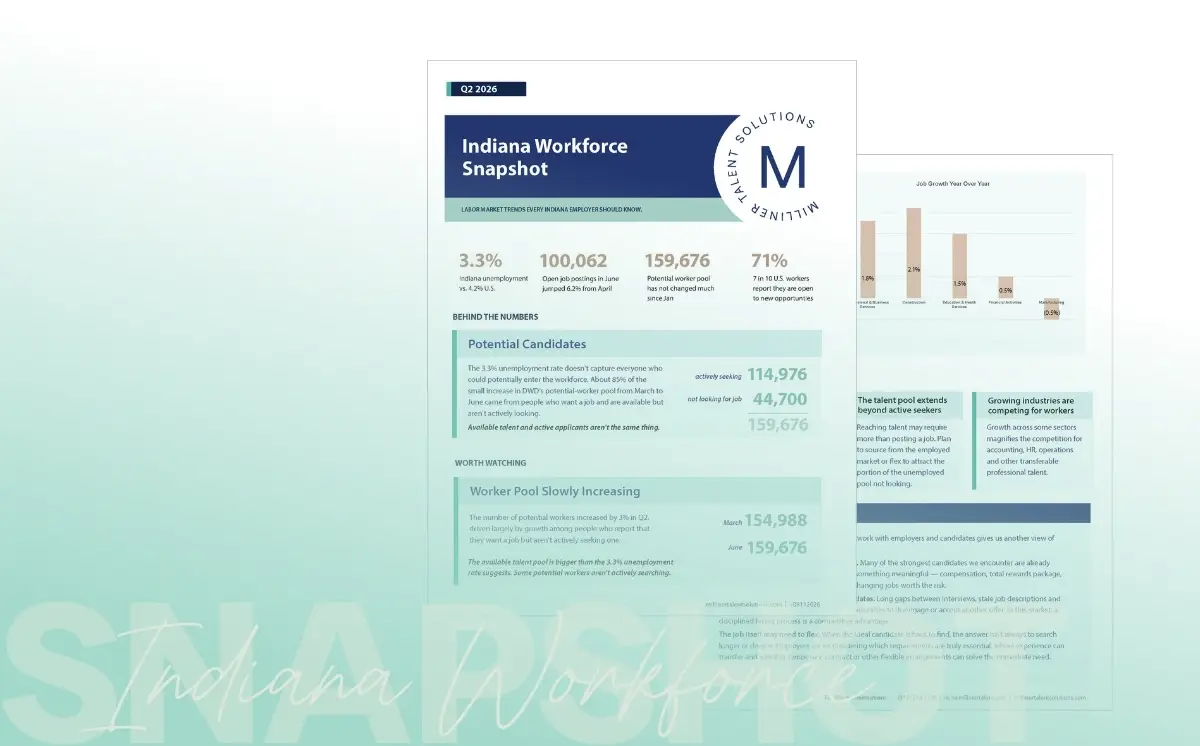
Indiana entered the second half of 2026 with 100,062 open job postings and an unemployment rate of just 3.3%.
At the same time, 114,976 Hoosiers were unemployed and actively seeking work.
That’s roughly 1.15 active job seekers for every open job posting.
But even that comparison makes the available talent market look larger than it really is.
An employer with an open accounting, HR, engineering or operations position isn’t choosing from 115,000 people. They’re choosing from the fraction who could realistically do that job.
The statewide talent pool isn’t your candidate pool
Start with 114,976 active job seekers.
Now narrow that number by occupation. Then experience. Geography. Compensation. Required skills or credentials. Schedule and work arrangement.
The pool gets smaller with every requirement.
Some requirements really are essential. But others may be preferences that have gradually become “must-haves” — five years of industry experience, knowledge of a particular software platform, a specific degree or experience in an almost identical role.
Individually, each may sound reasonable. But collectively, they can define a candidate who is extraordinarily difficult to find.
Every requirement has a cost: It reduces the size of the available talent market.
There isn’t one Indiana talent market
The market for an administrative position is different from the market for a controller. The market for an entry-level accountant is different from the market for an experienced engineering leader.
Even two employers hiring for the same title may face very different talent markets because of location, compensation, flexibility or required experience.
That’s why application volume can be misleading, too. Fifty applicants don’t necessarily mean there are 50 viable candidates.
The more useful question is: How many people in the market actually meet the requirements that matter?
Before expanding the search, examine the job
When employers aren’t finding enough qualified candidates, sometimes the answer is to keep searching. Other times, it’s worth revisiting what you’re searching for.
Which capabilities does the person absolutely need on Day One? Which could be learned? Does the person need experience in your industry
or could relevant experience transfer?
We don’t suggest lowering standards. We suggest separating the requirements that predict success from those that simply describe the
person who held the job before.
Compensation, location and work arrangements matter, too. Each decision further changes the number of people who might realistically consider the opportunity.
And the search doesn’t have to stop with active job seekers.
Indiana had approximately 3.38 million employed people in June. Some of
the strongest potential candidates may already be working and need to be
recruited rather than waiting for them to apply.
Know the market for the job you’re actually trying to fill
Indiana’s 3.3% unemployment rate provides useful context. So does the comparison between roughly 100,000 open jobs and 115,000 active job seekers.
But neither tells an employer how many qualified candidates are available for a particular position.
If a search is proving difficult, ask whether the requirements are truly essential, compensation is aligned with the market, location or work arrangements are restricting the pool and whether you’re reaching people who aren’t actively applying.
The statewide labor market may include 114,976 active job seekers.
Your talent market doesn’t.
Understanding the difference is where a smarter recruiting strategy begins.
We’re here to help.

The Indiana Workforce Snapshot provides a quick look at the labor-market trends Indiana employers should be watching — and our perspective on what those trends could mean for hiring decisions.